


Valeriia and I are launching a new community for AI builders: AI Shipping Labs. We’ve been collaborating on DataTalks.Club for quite some time, and now we’re creating something new.
I’ve mentioned AI Shipping Labs several times in this newsletter, but today we’re excited to officially announce the platform and invite you to join a live event on April 13 to launch the community for anyone interested in learning more.

In this post, we’ll share what the community currently looks like, what’s included, the benefits of joining as an early member, and our plans for the future.
Why AI Shipping Labs?
We’re living in an era of rapid change, with fast-moving trends pushing us into a constant rush to learn new “must-learn” concepts, frameworks, and tools without a clear direction.
This is true in AI, especially for people who want to build with these technologies.
You may find yourself in situations like these:
You already have a full-time job and still need to keep up. Meanwhile, your AI project keeps getting pushed to “next weekend.”
You want to move into a new role that requires new tools and a broader skill set. You keep asking yourself where to start, what to focus on, what to ignore, and how to prepare.
The flood of online resources doesn’t really help. You follow a tutorial, but still can’t build something on your own. Or you build a prototype, but it breaks in ways you don’t know how to fix.
In other words, you’re learning and building alone, without structure or support. And things stall.
If any of this resonates with you, you should be part of AI Shipping Labs.
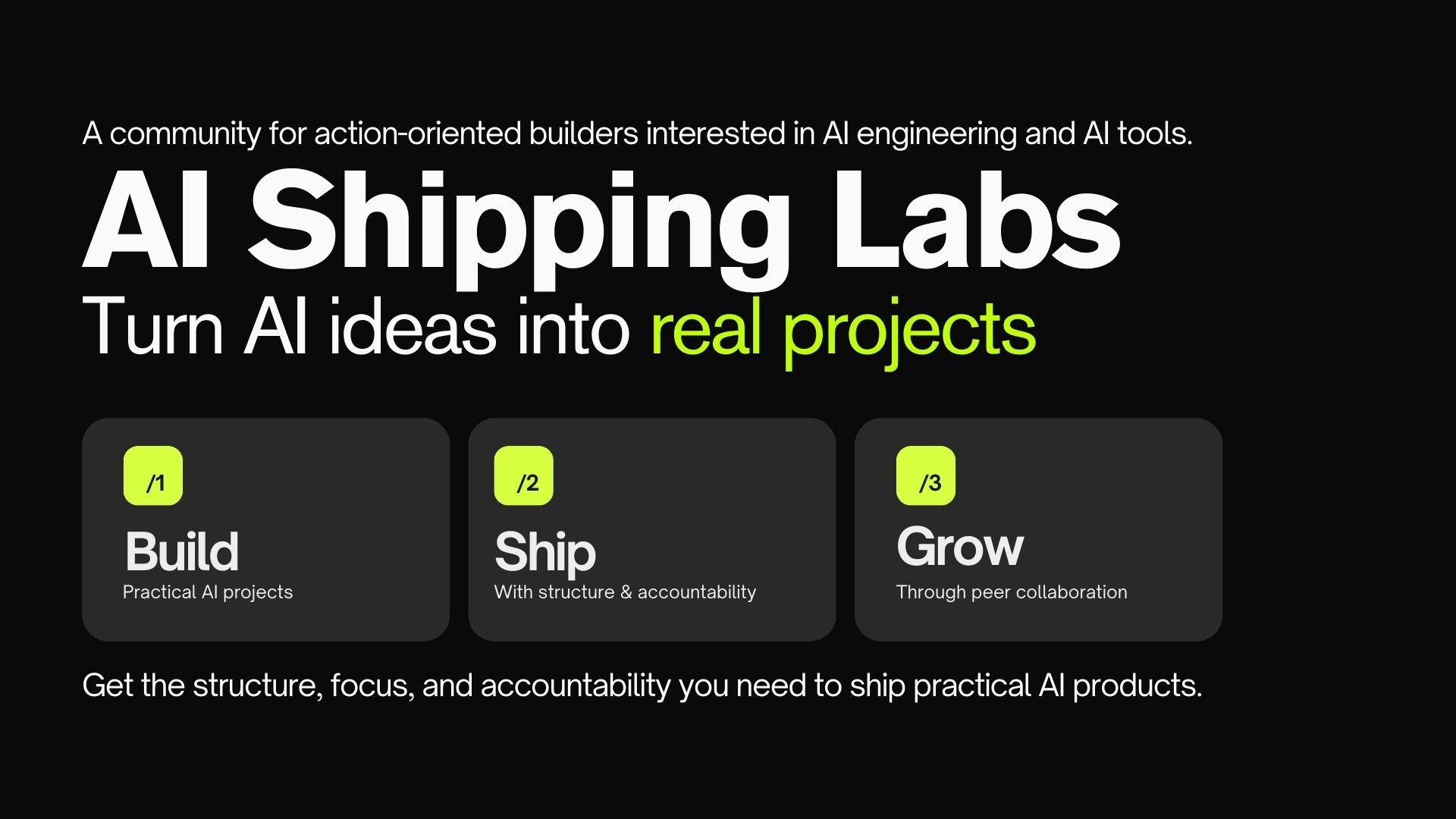
It’s a community where you learn to build AI products by actually building and shipping them, with a clear plan, a group of practitioners alongside you, and regular check-ins to help you keep moving forward.
What Happens Inside
When you join, you’ll get access to the Slack workspace, where you can connect with other members. As an early member, you also receive personal onboarding from me: a short call, a voice message exchange, or an asynchronous conversation. This is something I can offer while the community is still small.
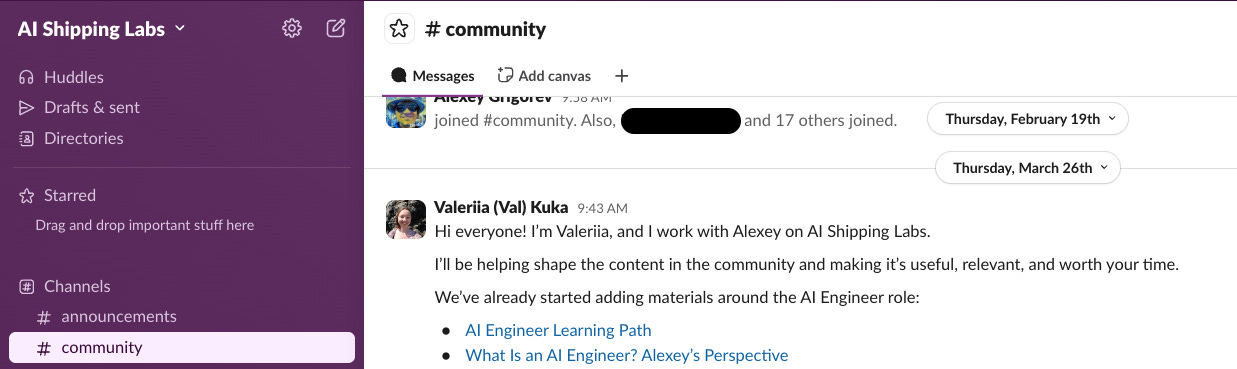
Together, we’ll figure out where you are now and where you want to go. You’ll get a clear plan, and the community will help you work toward it through these activities:
Accountability circles: mastermind groups with regular check-ins
Building sessions: regular live calls where we build something together
Group learning: going through courses and new materials together
Career support: resume reviews, personal branding, and conference speaking
Private discussions: interview prep, salary negotiations, and career moves
Courses: mini-courses on specialized topics
1. Accountability Circles
I get asked for mentoring all the time. I usually say no because I don’t have the bandwidth, and one-on-one mentoring doesn’t scale.
But I’ve realized that what most people actually need isn’t a mentor. They need an accountability structure: a plan, a deadline, and a reason to show up prepared.
So, we’re creating mastermind groups that run in sprints with a clear start and end. We connect you with people at a similar level. You work through different problems and share your progress on a set deadline, similar to a company standup: you share what you did, what you plan to do, and what’s blocking you. The group helps you work through those blockers, and you learn a lot from each other in the process.
2. Building Sessions and Group Learning
We meet live once or twice a month to build something together for 1.5 to 2 hours. Sometimes I bring a problem I’m working on, sometimes a member does. The focus is on solving real problems together, not watching slides.
For group learning, members pick a topic, research it, and present their findings. We also go through new courses and materials together. Having a cohort makes it much easier to stay on track.
3. Career Support and Private Discussions
You can get help from the community with resume and LinkedIn reviews, including feedback from people who have been through the hiring process and know what works.
We also help with personal branding: learning in public, creating content on LinkedIn and X, and building a presence that opens up new opportunities.
Because it’s a private community, you can also talk about things you wouldn’t bring up publicly: what companies are asking in interviews right now, how to negotiate a better offer, or whether it’s time to leave your current job.
4. Courses
Mini-courses on specialized topics are also coming. They’ll be shorter, for about several weeks, and more focused than a full Buildcamp.
As an early member, you can help shape what gets built. Members vote on which courses to develop next.
Some ideas we already have:
Python for AI Engineering: a comprehensive Python course for AI engineering preparation, but also useful anywhere Python is needed
Spec-Driven Development for AI: how to write clear specifications and manage a team of AI agents
Refactoring AI Slop: how to deal with AI-generated code that has too much boilerplate, too much defensive coding, and is hard to maintain
These are our current ideas, but what actually gets built will depend on what the community needs.
What You Get Right Away
As I already mentioned, when you join, you’ll receive an invite to the Slack workspace. As an early member, you’ll also get personal onboarding from me and the chance to shape the community’s structure, session formats, and priorities.
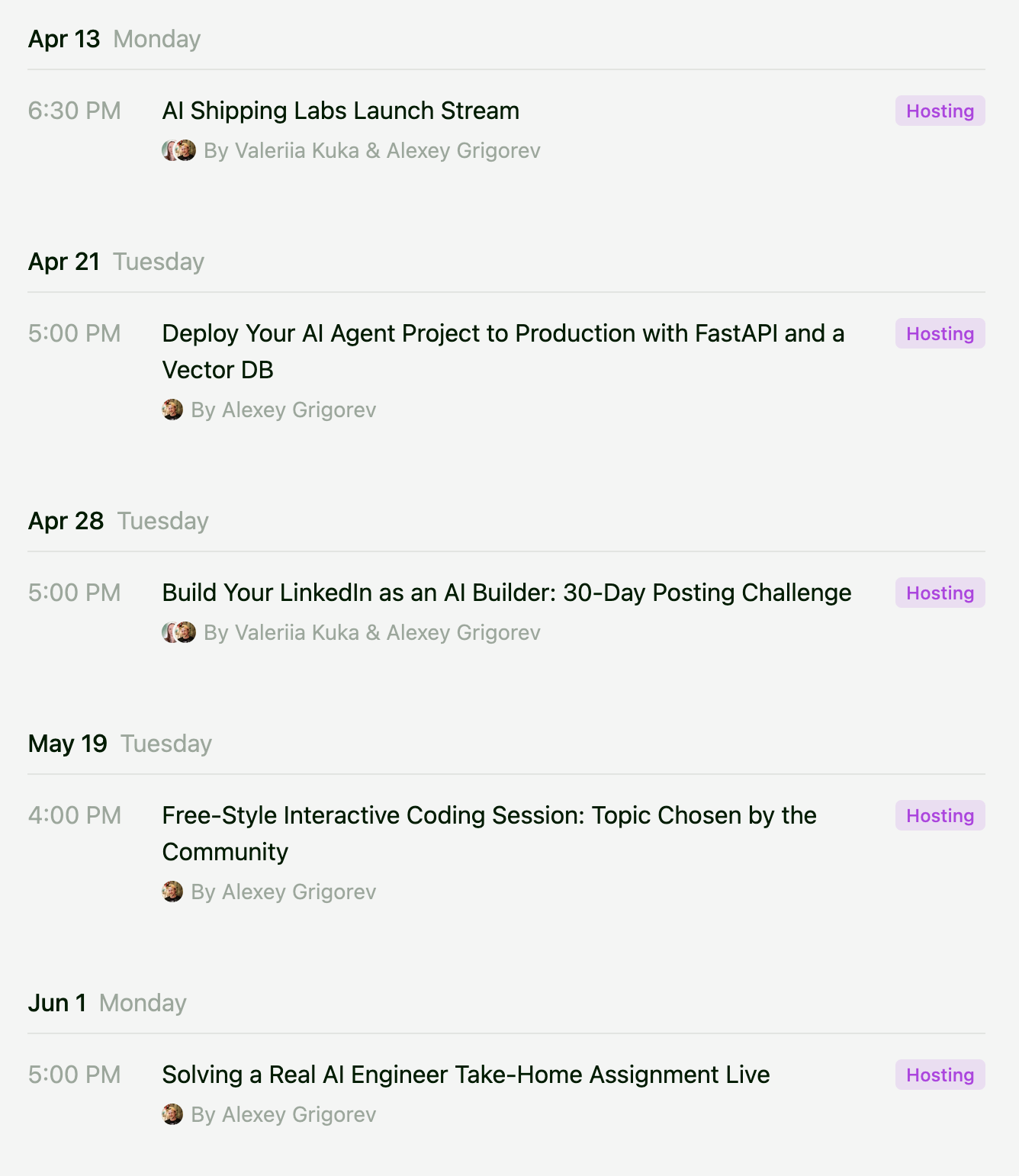
Additionally, you’ll have access to the upcoming events in April and May:
Workshop: “AI Engineer Project to Production with FastAPI and Vector Database,” led by me
Webinar: “Build Your LinkedIn,” led by Valeriia, focusing on content ideas and personal branding workflows, along with the introduction of a 30-day posting challenge for community members.
Interactive Coding Session, with the topic chosen by community members, led by me
Workshop: “Solving a Real Take-Home Assignment for an AI Engineer Role Live,” led by me
How to Join
Head to aishippinglabs.com, select the plan, and sign up!
This is a brand-new platform, so some automations might not work perfectly yet. If you sign up and don’t get access automatically, just reply to this email, and I’ll sort it out for you!
What’s Coming
We’re also building the full version of the platform, with authentication, access levels, a course catalog and progress tracking, community calendar, newsletter, topic and course voting, and more. This is the same website behind the story that recently went viral, about how I dropped our production database with Claude Code.
Right now, the main website is still running on the Next.js version that Valeriia built. I’m continuing to work on the new version, and once it’s production-ready, it will replace the current one.
A project like this would traditionally take six months to a year to build. We got a working platform in weeks.
We’ll share how we built both versions of the website in the second part of this newsletter, which is coming soon. Subscribe to get updates.
Why Another Community?
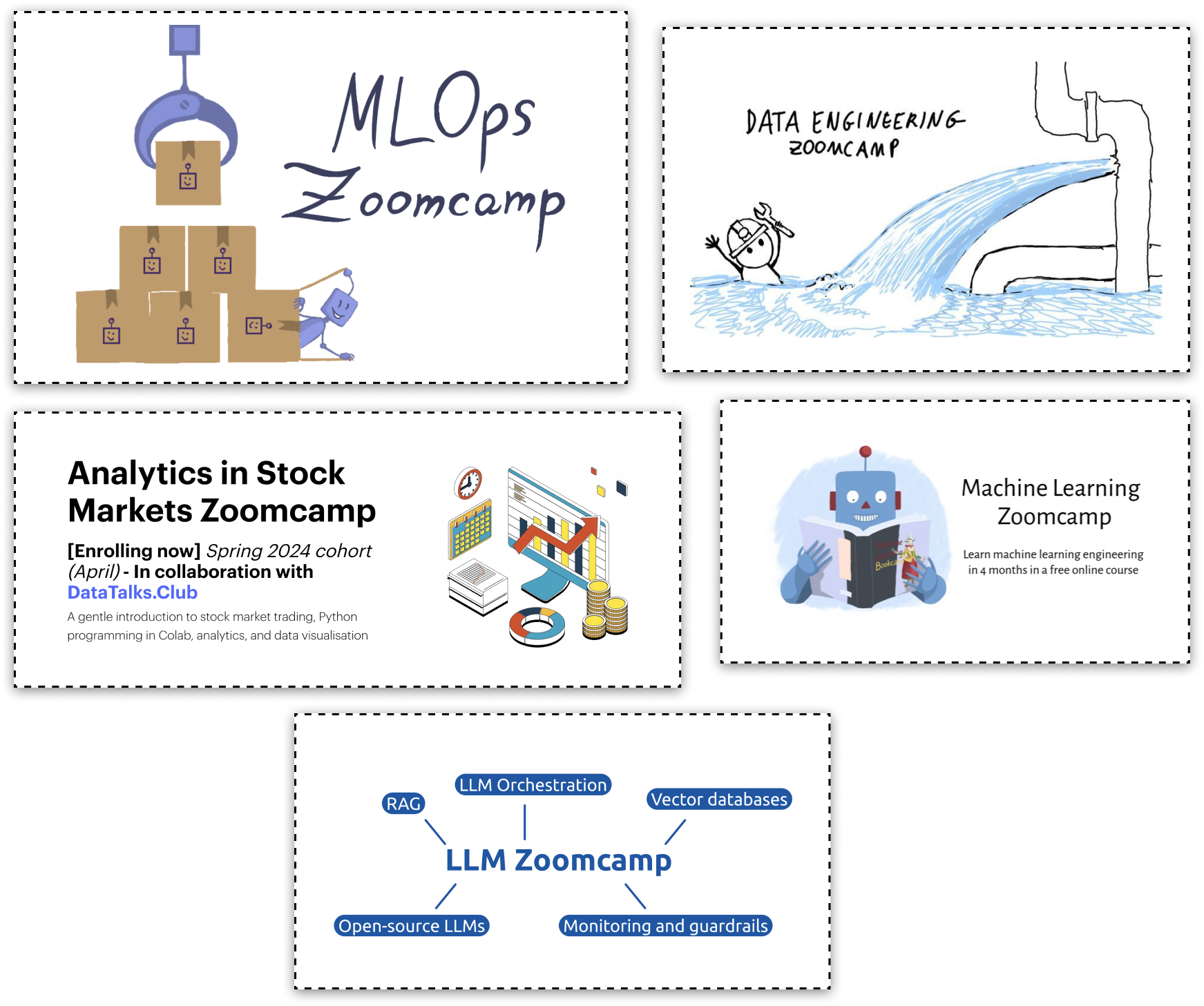
Many of you know me from DataTalks.Club. That’s not changing. The principle of free education for everyone stays the same. All of the free Zoomcamps continue to exist, and I run one cohort of each every year.
But for a while, I’ve wanted to build something different. The idea came together step by step.
First, I ran the AI Engineering Buildcamp on Maven, and the students showed me there’s real demand for structured, paid learning. They were engaged and wanted to keep going after the course ended.
Then I started this personal newsletter, a place to share what I learn and try every day, separate from DataTalks.Club.
That made me want a smaller group where I could go deeper: live sessions, solving problems together, exchanging experiences.
Over time, all of that came together naturally into a community.
What I’ve Been Working On Recently
1. Workshop at Data Makers Fest 2026

I’ve been preparing a hands-on workshop for Data Makers Fest 2026 in Porto.
During this session, I’ll show how to go from a simple RAG system to an agentic search workflow. It’s designed to be practical, so you can build the system step by step and leave with a much clearer understanding of how these applications work in practice.
If you’d like to join, you can use the code DATATALK10 for 10% off. Tutorial tickets are available until April 24.
2. AI Engineering Buildcamp
Last Call for AI Engineering Buildcamp

Next Monday (April 13), I start another iteration of the AI Engineering Buildcamp, a course that teaches AI engineering by building.
Next Monday, April 13, I’m launching another iteration of the AI Engineering Buildcamp, a course where you learn AI engineering by building real systems. I’ve put a lot of work into the course.
After it concludes, I do not plan to run another cohort in the nearest future. I want to take a break from the course and focus on AI Shipping Labs for a while.
So if you’ve been thinking about joining, don’t wait too long. Registration is still open, and you can sign up using the SUBSTACK promo code for 20% off for newsletter subscribers.
3. New cohort of the AI Agents Email Crash Course
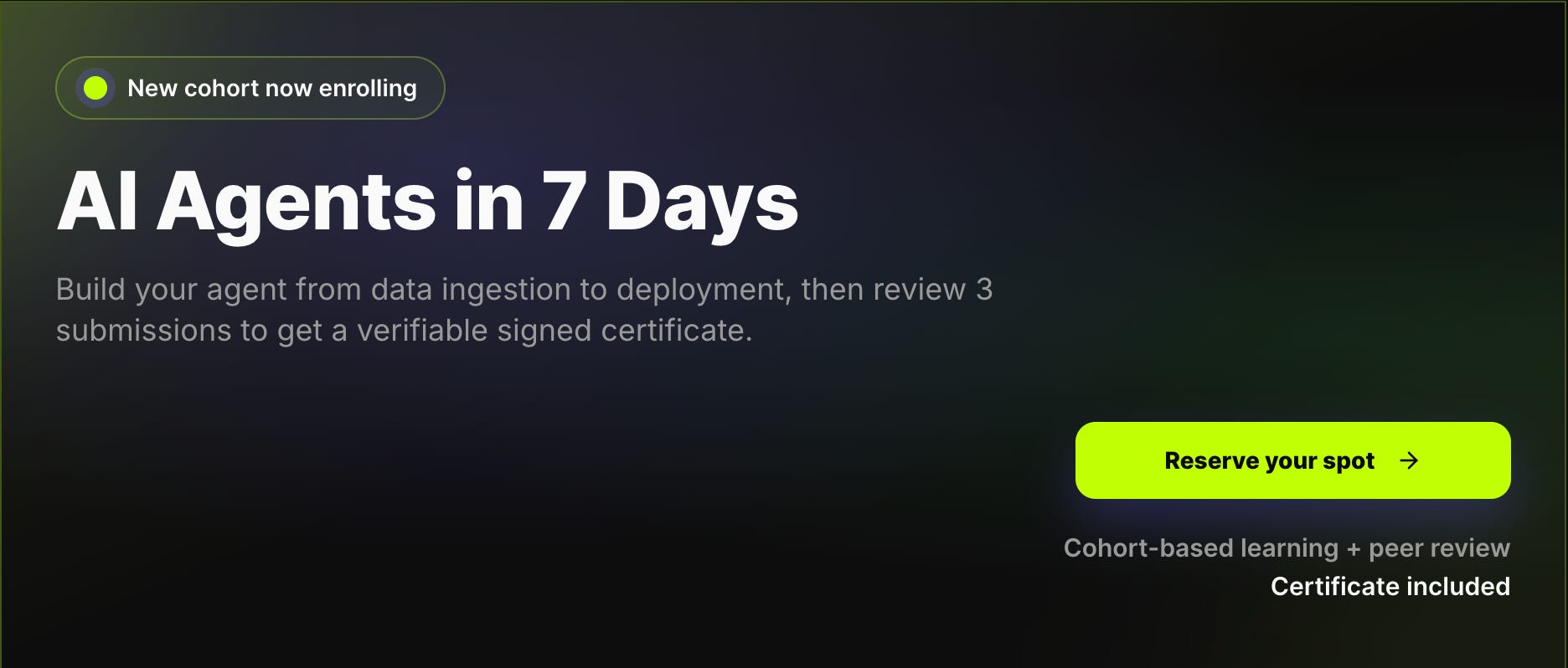
I started a new cohort of the AI Agents Email Crash Course. It’s a free, structured, project-based way to learn how AI agents work.
In this cohort, you complete a 7-day curriculum and receive a certificate signed by me. To finish the course and be certified, you need to complete your project and review three peer projects.
Tools
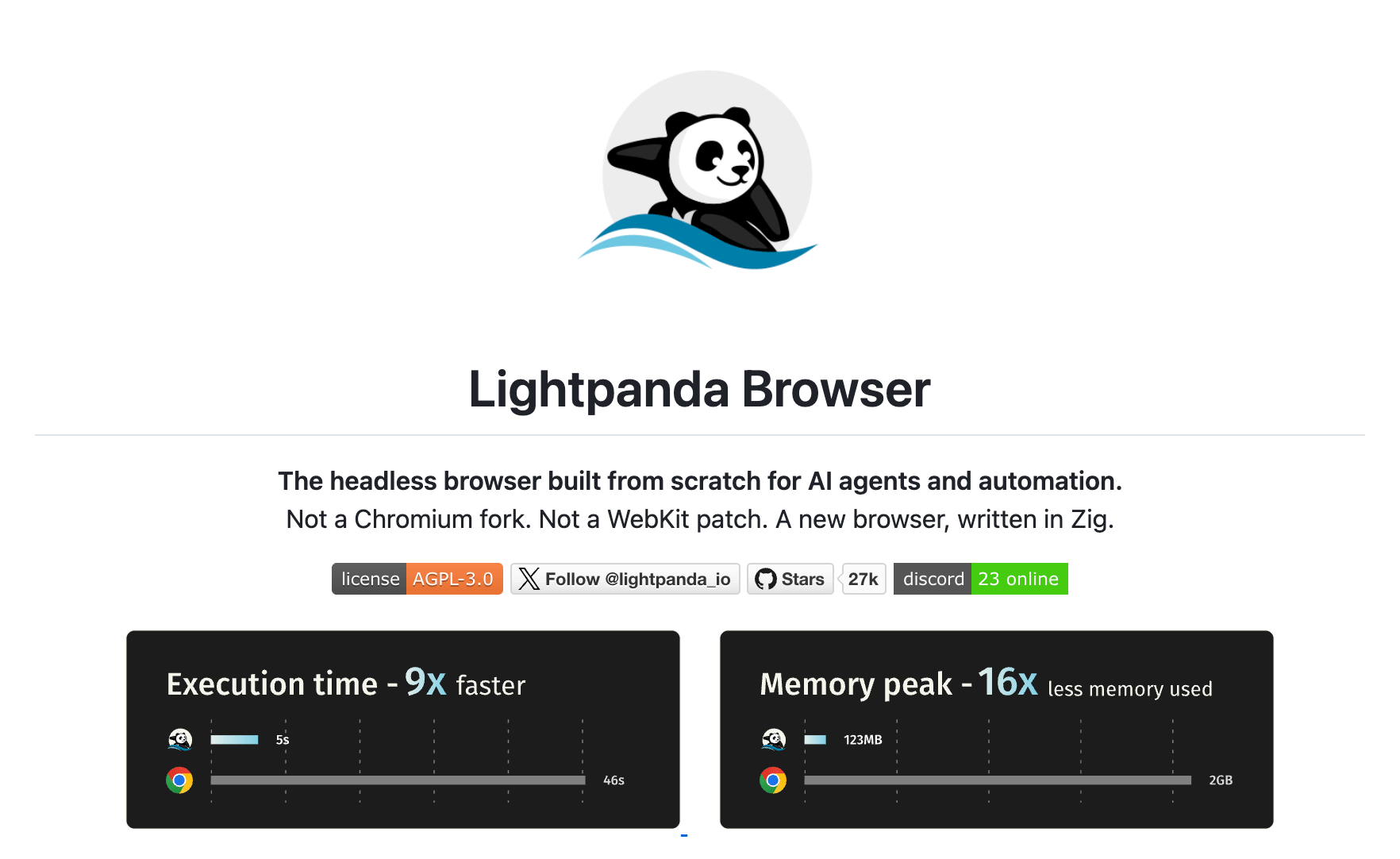
Lightpanda Browser is an open-source headless browser built from scratch in Zig, designed specifically for AI agents, web scraping, and automation. It claims 11x faster execution and 9x lower memory usage than headless Chrome, while remaining compatible with Playwright, Puppeteer, and other tools via the Chrome DevTools Protocol. With over 12,000 GitHub stars, it is a promising lightweight alternative for anyone running browser automation at scale without needing graphical rendering
QMD is a local-first search engine for Markdown files that combines BM25 keyword search, vector semantic search, and LLM re-ranking - all running on-device. It works as a CLI tool, a Node.js/Bun library, or an MCP server, making it easy to plug into agentic workflows for searching across notes, docs, and meeting transcripts. Similar in spirit to minsearch but designed for Markdown collections, it is especially convenient for giving AI agents fast access to your local knowledge base
Resources

My explainer of MemPalace, an open-source AI memory project launched by Milla Jovovich and developer Ben Sigman. The post examines its local, deterministic approach to long-term memory and explains why its memory-palace-inspired design stands out from more model-heavy systems.
Wikipedia: Signs of AI Writing is a practical, community-maintained checklist of common AI writing signals, from hypey or superficial phrasing to repeated vocabulary and formatting artifacts. Useful for spotting LLM-generated text and for editing drafts to sound more natural and human.
Is community already launched?